
What is the Ocean Literacy Framework?
The Ocean Literacy Framework comprises:
- the Ocean Literacy Guide, describes the 7 most important ideas, or Essential Principles, about the ocean that everyone should know. The 45 Fundamental Concepts support and add detail to the Essential Principles.
- the more detailed Ocean Literacy Scope and Sequence for Grades K–12,
- the Alignment of Ocean Literacy to the Next Generation Science Standards,
- the International Ocean Literacy Survey.
Development of the Ocean Literacy Framework was a collaborative effort involving scientists and educators in the ocean sciences education community, where MARE has held a leadership role from the beginning.
Ocean Literacy Principles
There are seven essential principles, supported by 45 detailed fundamental concepts:
- Ocean Literacy Principle 1. Earth has one big ocean with many features.
- Ocean Literacy Principle 2. The ocean and life in the ocean shape the features of Earth.
- Ocean Literacy Principle 3. The ocean is a major influence on weather and climate..
- Ocean Literacy Principle 4. The ocean makes Earth habitable.
- Ocean Literacy Principle 5. The ocean supports a great diversity of life and ecosystems.
- Ocean Literacy Principle 6. The ocean and humans are inextricably linked.
- Ocean Literacy Principle 7. The ocean is largely unexplored.
The Ocean Literacy Principles are:
- the big ideas in ocean sciences that every person should understand by the end of high school;
- derived from a consensus-building process involving over 100 ocean scientists and educators;
- correlated to the Next Generation Science Standards (NGSS);
- a work in progress—they reflect our efforts to date defining ocean literacy.
Scope and Sequence
To facilitate teaching and learning the Ocean Literacy Principles by high school graduation, the ocean sciences education community developed a scope and sequence to show how the principles could be taught at various grade bands. The Ocean Literacy Scope and Sequence is comprised of 28 conceptual flow diagrams, one for each grade band (K–2, 3–5, 6–8, 9–12) for each principle. These diagrams show, graphically:
- the science concepts underlying the principles and how they are connected;
- developmental appropriateness—what students need to know to help them understand the higher level concepts; and
- how instruction of the concepts might “flow.”
Together these documents form the Ocean Literacy Framework. The Framework is a resource for educators and scientists with a “roadmap” that helps them build coherent and conceptually sound learning experiences for students from Kindergarten through 12th grade. Both of these documents are also available in print and download forms.
This framework presents a vision of an ocean-literate society and outlines the knowledge required to be considered ocean literate. More information about the framework, including the honor roll of contributors, is available.
Access the Ocean Literacy Framework at the NMEA Ocean Literacy website.
Ocean Literacy: The Essential Principles and Fundamental Concepts of Ocean Sciences for Learners of All Ages
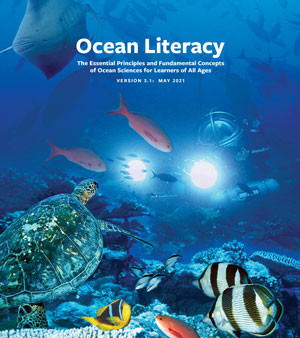
The Ocean Literacy: The Essential Principles and Fundamental Concepts of Ocean Sciences for Learners of All Ages describes the 7 most important ideas, or Essential Principles, about the ocean that all people of our water planet should have the opportunity to learn and understand. The Essential Principles and supporting Fundamental Concepts were developed through a community-wide consensus-building process. This effort built on previous work to define ocean literacy, assess what the public knows about the ocean, and redress the lack of ocean-related content in state and national science education standards, instructional materials, and assessments.
Hard copies may be requested from NOAA’s Outreach Office by emailing education@noaa.gov. In your email, please indicate the number needed, when needed, and an address where they should be shipped. Please note: at this time, expedited shipping is not available. Please plan ahead.
Ocean Literacy Scope And Sequence For Grades K-12
The Ocean Literacy Scope and Sequence for Grades K–12 provides educators with guidance as to what students need to comprehend in Grades K–2, Grades 3–5, Grades 6–8, and Grades 9–12 in order to achieve full understanding of the Ocean Literacy Essential Principles and Fundamental Concepts.
The Alignment Of Ocean Literacy To NGSS
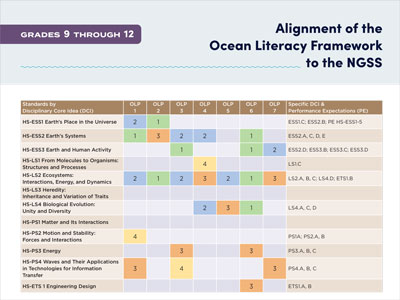
The Alignment of Ocean Literacy to the Next Generation Science Standards (NGSS) describes the correlations between NGSS and the concepts included in the Ocean Literacy Guide, and the Ocean Literacy Scope & Sequence.
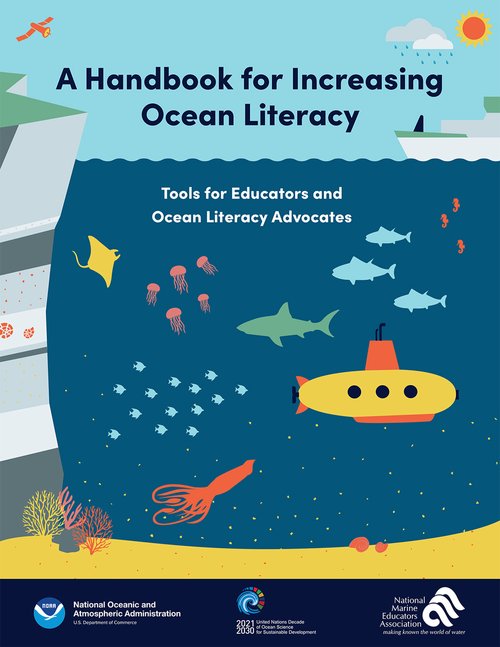
A Handbook For Increasing Ocean Literacy
A Handbook for Increasing Ocean Literacy: Tools for Educators and Ocean Literacy Advocates was developed by the National Marine Educators Association, with the support of NOAA, to help educators and other ocean advocates teach, learn, and communicate about the ocean. Included are the 28 conceptual flow diagrams of the Ocean Literacy Scope and Sequence for Grades K–12, an article explaining the theoretical basis for the scope and sequence, the Ocean Literacy Alignment to Next Generation Science Standards, as well as brief explanations about how to use these tools, their origins, and purposes.
This publication is an endorsed activity supporting the UN Decade of Ocean Science for Sustainable Development.