3rd–5th
MARE Teacher’s Guides to Marine Habitats: 3-5
The MARE Teacher’s Guides to Marine Habitats provide an outstanding resource for engaging a whole school simultaneously in the study of a common theme—MARE offers extensive professional learning around using the curriculum this way.
The Guides address earth, physical and life sciences; language arts; environmental and social justice issues; art and music.
The Guides are designed for ALL learners. They incorporate research on learning and teaching throughout the curriculum promoting English language development along with complex understandings of science concepts. For an exemplar activity—see Apples and Ocean (5th grade). (PDF, 815kb)
-
3rd Grade–Wetlands
This curriculum includes activities that investigate the relative densities of water, map organism foodweb connections, use data analysis to examine habitat resource use, and experimental design to learn more about animal adaptations.
-
4th Grade–Kelp Forest
Download the Kelp Forest Teacher Guide Now Gazing from shore at the gently swaying surface of a kelp forest canopy, it’s difficult to imagine the activity below. But from holdfast to blade this algal forest is home to bizarre invertebrates and fish of every imaginable color, size, and form. It’s also the unique home of…
-
5th Grade–Open Ocean
This curriculum (MARE Teachers’ Guide to Open Ocean and GEMS Ocean Currents and Only One Ocean) includes activities for students to examine the causes and effects of connected ocean basins and ocean currents, make evidence-based explanations for animal adaptations, and work with real-data to design solutions for sustainable fisheries.
View MARE Teacher’s Guides to Marine Habitats: K–5
3rd-5th
Ocean Sciences Sequence for Grades 3-5
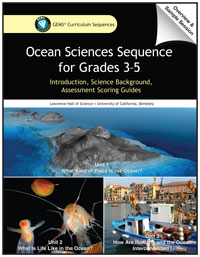
Purchase the Teacher’s Guides through the Discovery Corner at Lawrence Hall of Science now!
Need more information? Please contact: spedemonte@berkeley.edu
Funded by NOAA, the Ocean Sciences Curriculum Sequences are in-depth, kit-based curriculum units that deliver rich science content correlated to the Next Generation Science Standards (NGSS), with an emphasis on the Practices of Science as called for in NGSS and the Framework for Science Education K–12, and significant overlap with the Common Core State Standards for English Language Arts.
There are three thematic units based on the Ocean Literacy Essential Principles and Fundamental Concepts as well as the Ocean Literacy Scope & Sequence for Grades K–12. Each unit may be taught independently or as a progression of all three units and is appropriate for all three grades.
The Grades 3–5 Sequence engages students in exploring ocean currents, features of the ocean floor, ocean habitats, ocean organism diversity, ocean food webs, adaptations to the ocean environment, and human interconnections with the ocean including exploration, technology, pollution and solutions. This upper elementary curriculum prepares students to understand the climate ocean connection and climate change curriculum they will be exposed to in middle school.
- Unit 1: What kind of place is the ocean? covers Earth and physical science themes about the ocean as a physical space with unique characteristics (e.g., features of the ocean floor; properties of ocean water such as salinity, temperature, and pressure; and ocean currents).
- Unit 2: What is life like in the ocean? covers life science themes, with a specific focus on food webs, habitats, and adaptations.
- Unit 3: How are humans and the ocean interconnected? covers life science and environmental science themes, with a specific focus on pollution, fisheries, and how people use and can help care for the ocean.
Curriculum 3–5 Resources. This page contains links to videos, computer simulations, and lists of other recommended materials that support and supplement this curriculum.
Curriculum Sampler (PDF, 15.9MB). Provides you with an in-depth introduction to this and other GEMS Sequences, a complete set of session summaries, and the Teachers Guide pages for one session of the curriculum.
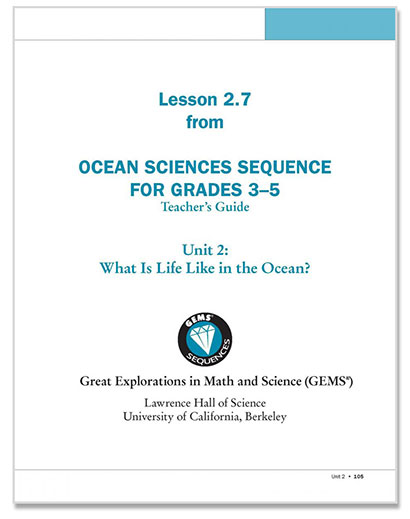
Sample Lesson (PDF, 20MB). This document provides all the Teacher’s Guide information and direction pages, as well as all the materials and resources needed to teach this lesson. In Session 2.7 An Open Ocean Food Web, students learn if one type of organism is removed from a habitat, many other organisms could be affected.
Alignments with NGSS (PDF, 20MB)
Find out how the curriculum aligns with the Next Generation Science Standards.
Contact us for more information on professional development opportunities.